
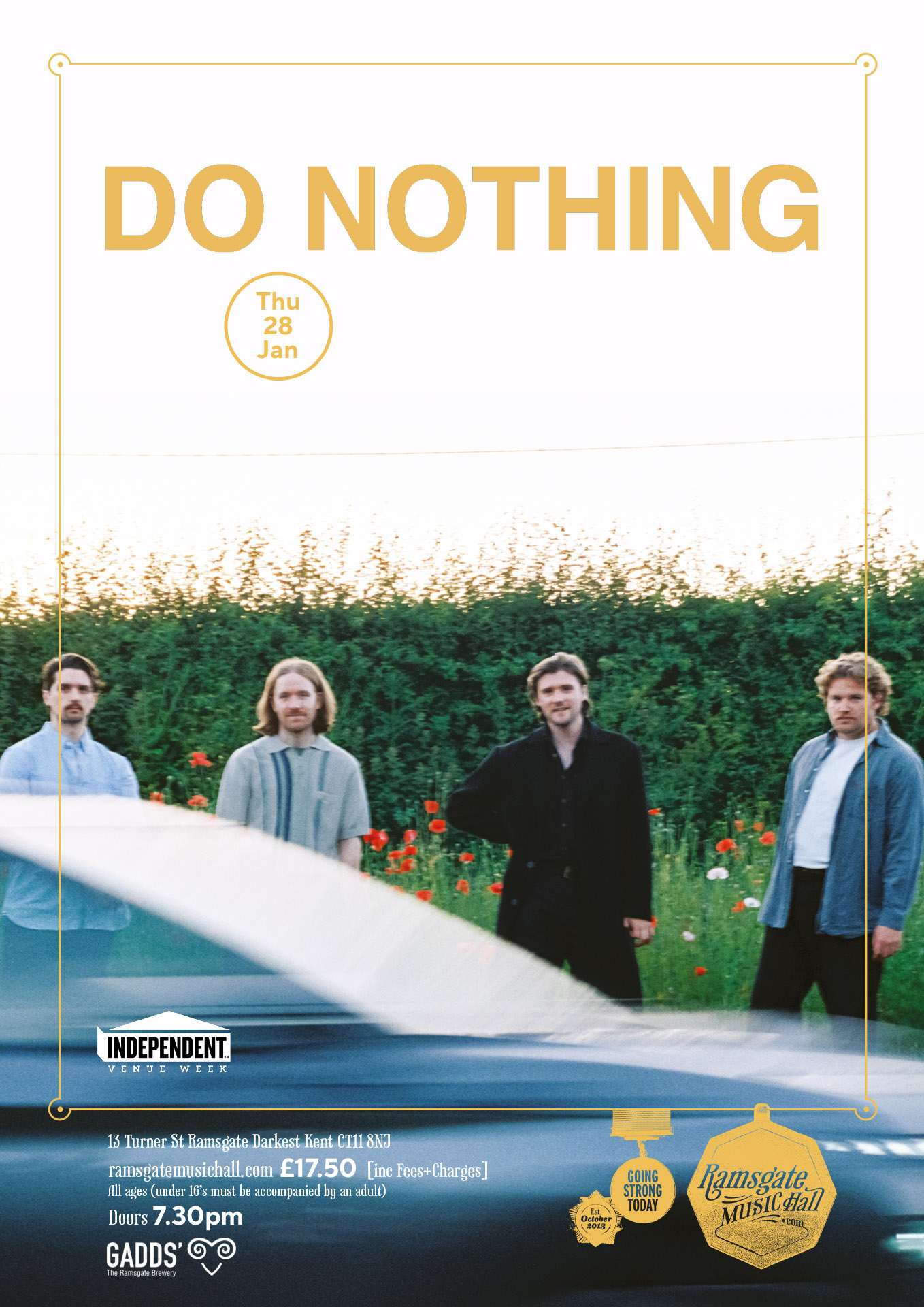
It’s been three years since Nottingham’s Do Nothing released their critically-acclaimed debut album ‘Snake Sideways’, but it’s taken until now for them to find the catharsis that’s usually expected from such a landmark. Described to the press as “a self-referential freak-out about pressure”, the band were still processing that album’s creation as they careened from BBC Radio 6 airwaves to UK stages, European festivals, and SXSW in the States after its release. “As soon as that bit was done,” says Bailey, “I was able to write new music with no expectations, things got easy very quickly. ”
With the band on a fresh path, Do Nothing embraced the freedom to explore different sounds, themes, and even “things that are a bit daft” with enthusiasm. But the breakthrough that formed the central foundation for sophomore album ‘Friend World’ ultimately came from a surprisingly banal place, as singer Chris Bailey found a kind of self-reflexive enlightenment while doused in madras and Holsten Pils:
“I had the house to myself, so I had a big curry and watched stuff on the internet,” Bailey explains. “I was watching the comedian/performance artist Andy Kaufman on YouTube, who has a famous ‘bit’ where he has an onstage breakdown, starts crying, and then turns the rhythm of his sobbing into a bongo solo.” Kaufman’s intentional “bombing” during seemingly sincere stage performances exemplifies what Bailey calls his “purposeful disconnection” from other people. “He makes it look like he’s a weirdo who’s trying his best, and he did this his whole life — nobody could tell whether he was like that for real. What I took from it the most, though, was that idea of being a willing outsider.”
That evening opened the door to a deeper exploration of aloof and eccentric real-world figures on Bailey’s part thereafter. “I find myself seeking out these lonely and sad people because I find them interesting and can relate to them,” he says. “Once I find the depressed dude at the party, I want to talk to that guy the whole night.”
Such figures would later inform Bailey’s own menagerie of “outsider” characters, whose perspectives are adopted throughout ’Friend World’ via the singer’s trademark wit and stream-of-consciousness lyricism. Drawing from the dark recesses of the universal life experience, the album forefronts introversion, awkward social interaction, and even self-deprecation and self-destruction.
It all comprises some of the most compelling storytelling that Bailey has ever captured as a vocalist. Take ‘Smile’, with its wonky bass swagger and refrains of “how good it is to be alone at last” — a song inspired by an online cartoonist who suffered from schizophrenia and took his own life, the singer explains. “He was obsessed with this puzzle book that was basically unsolvable, and made a sprawling, poorly drawn comic [that concluded with] his suicide note. It’s a difficult and often incomprehensible read, but I was really inspired by it.”
Elsewhere, between acoustic ballads with titles that speak directly to their characters’ shuttered existences (‘Loner’; ‘Incommunicado’), ‘Yes’ takes inspiration from children’s writer Helen Palmer, who was diagnosed with Guillain–Barré syndrome and spent months living inside an iron lung in the 50s. “She was the wife of Dr Seuss and, despite her being nothing but supportive to him, he started a longstanding affair with one of their family friends, and she was heartbroken,” says Bailey. Brooding lead single ‘Stars’, built on “cheap” Roland drum machines and “expensive” ‘80s synths, draws from similar material: unrequited love for “hideous, careless men”, as captured in Elizabeth Smart’s 1945 novel ‘By Grand Central Station, I Sat Down and Wept’. “It’s full of this very intense prose poetry about Smart’s 18-year-long involvement with another poet; a manwho fathered 15 children with four different women, explains Bailey. “She was shattered by it all.”
As the songs developed, the band decamped to JT Soar, at the back of Sneinton Market, for three-and-a-half weeks of recording. The ex-fruit and veg warehouse has long been a hub for the local Nottingham music scene, and even features a Sleaford Mods mural. “We’d done the first album at a big studio in London, so it was appealing to do the second a bit more ‘in-house’,” says drummer Andrew Harrison. “JT Soar is literally 30 seconds from [guitarist] Kasper’s front door, so it was as comfortable as could be – even if they did have to strip down the live room to host a gig every now and then.”
Production was handled by Louis Milburn of former Do Nothing tour-mates Folly Group, and an already-established creative shorthand enabled the band to incorporate everything from “little synth flourishes” to full-on genre breaks, as the album seamlessly bounces from skittering beats and trash can guitars (‘Misery’) to phaser pedal clav funk (‘Act Natural’) and teardrop ballads (‘These People Want Blood’).
This playfulness is further defined by moments that hark back to the band’s surrealist roots: just as songs about famous basketball players and football clichés have defined their past output, ‘Dog 2’ concerns two confused dogs struggling to understand the concept of a party, while ‘Paris Jesus’ finds Bailey cooing about sending emails in his sleep. It’s an effective foil to the darker undertones just beneath the album’s surface — a polarity also alluded to in the title:
“On the face of it, the album is about lots of bleak stuff,” Bailey reflects. “But it doesn’t represent that to me. I enjoyed making it in a way that I haven’t with anything else we’ve ever made, and I’m more proud of it than anything we’ve done. So the name ‘Friend World’ is intended to be a duality: a happy-clappy title for a lot of sad songs.”
The title’s origin came out of that same curry-doused evening on the sofa. At the end of Kaufman’s comedy shows, he would often sing a song called ‘This Friendly World’, by the American singer Fabian: “in this friendly, friendly world, with so each day so full of joy, why should any heart be lonely?”
“It’s a very happy-sounding tune that gives off super sinister vibes,” Bailey concludes. “I find it impossible to take the lyrics at face value. That night, I slowed it down and put it at the start of a song I had already written, and named it ‘Friend World’.” The song ultimately didn’t make the album, says the singer, but the idea stuck: “It went on to make sense with everything else that came after.”
Words: James Balmont